


Our SE Asia adventure 2026: you might risk your life crossing the streets, but you just might achieve coffee nirvana (and see a few sights) in Hanoi, Vietnam
Updated: Apr 4
After a visit to the humble UNESCO area of Luang Prabang, Laos - if you’d like, see my blog “Our SE Asia Adventure 2026: Luang Prabang, Laos - respect the diversity (and be sure to buy some Laotian Kip for those deep-fried bananas)” - we took a deep breath and headed for Hanoi, Vietnam. We went with a long list of warnings about the traffic and congestion and people - and diligence and bravery required to cross a street.
Before I get started, Hanoi is a big city with lots to know, and I try to be accurate, but always do your own research.
On our evening drive from the airport, we soon realized that Hanoi mixes modernism with tradition:
The warnings about congestion weren’t wrong. Stop signs and lane markings appear to be merely a suggestion. If we thought Bangkok was chaotic, it now seems rather serene in comparison. Hanoi holds about 8.8 million people in the city with over 19 million in the broader metropolitan area. The city grows by 200,000 people per year. The area has boomed since 1985 when there was just one million people which, I imagine, means a strain on all forms of infrastructure and services. That population density also means about seven million motorcycles (many poorly-maintained) which are blamed for the poor air quality. The situation is so bad, steps are being taken to gradually enforce rules and restrictions regarding fossil-fuel vehicles. See “Hanoi plans time-based ban on gasoline-powered motorbikes in downtown areas from 2026” at en.vietnamplus.vn for an informative read. The population density averages about 2,300 people per square kilometre, but the downtown area is estimated to have over 30,000 per square kilometre. The city apparently reached its 2030 population estimates years ago. There is much to read online about Hanoi’s population pressures, if you are interested.

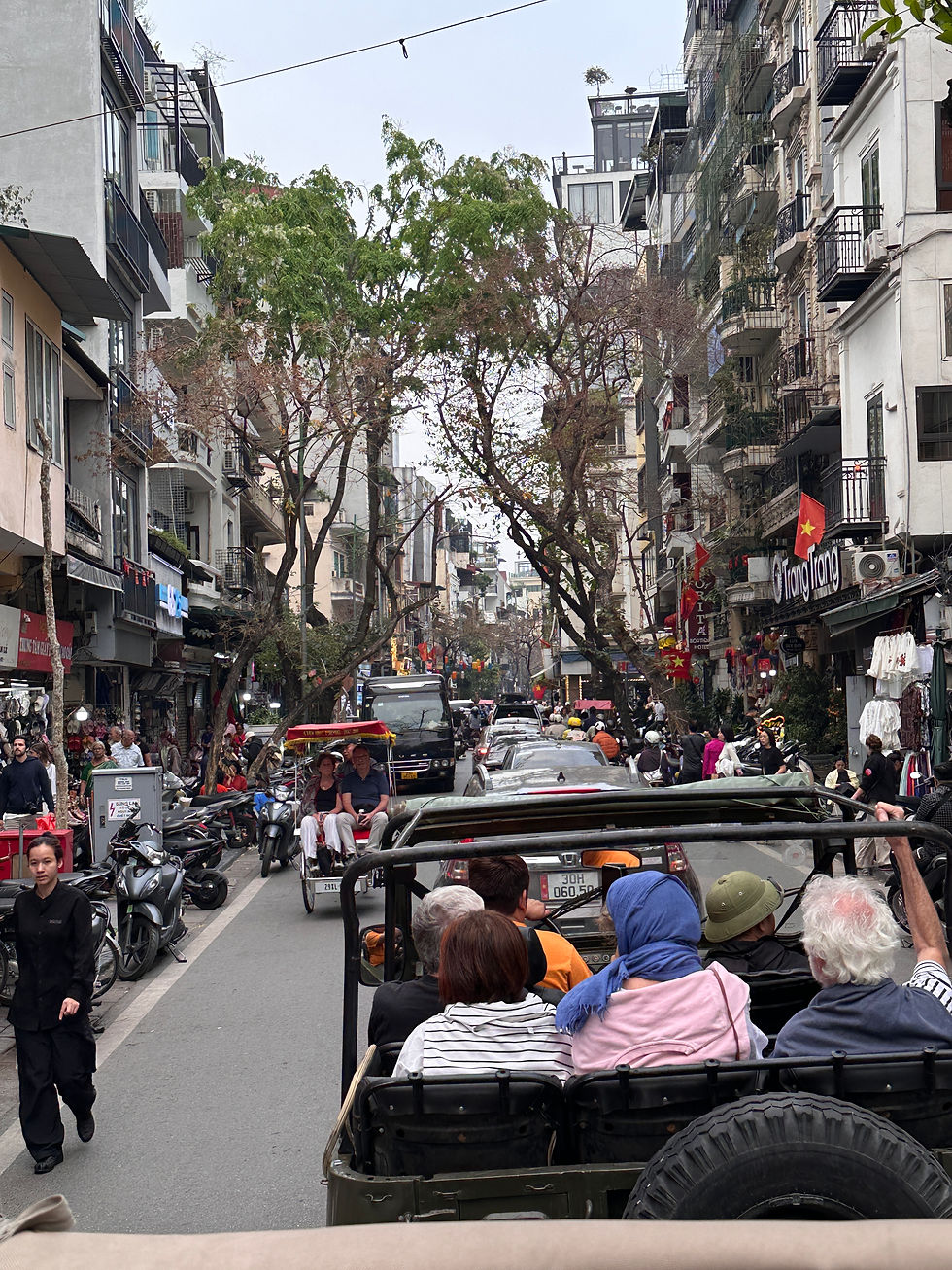
So, you get the picture - Hanoi is busy. I think we figured out how to cross the streets, not safely but staying alive. Wait for any small gap in traffic, hold out a hand, and walk fast. Trust the cars, scooters, bicycles, tour vans, and rickshaws to maneuver around you and (maybe) slow down just a bit. They are all exceptional drivers.
As we all know, Vietnam suffered through the Vietnam War (or, as it’s known, the “American War”) from 1955 to 1975 which is a horrendously long period for a country to be at war. Of course, there are reams of information available about this war and American involvement on line. I am no historian, and wars are complicated with many competing interests, so please do your own research if you are interested.
So, the war ended some 50 years go, and Vietnam has come a long way, starting in 1986 when the Communist Party initiated reforms encouraging private enterprise and foreign investment. In 1994, the USA lifted trade embargos, and in 2007, Vietnam joined the World Trade Organization. A good article about the Vietnam economy is “Vietnam’s economy: The remarkable story of the last 50 years” by Phan Chi Lan, et al, at voxdev.org.
There is much to see in Hanoi between some historic sights and the chaotic ambience of the streets, and I initially thought we had not seen a true reflection of the city, but . . .
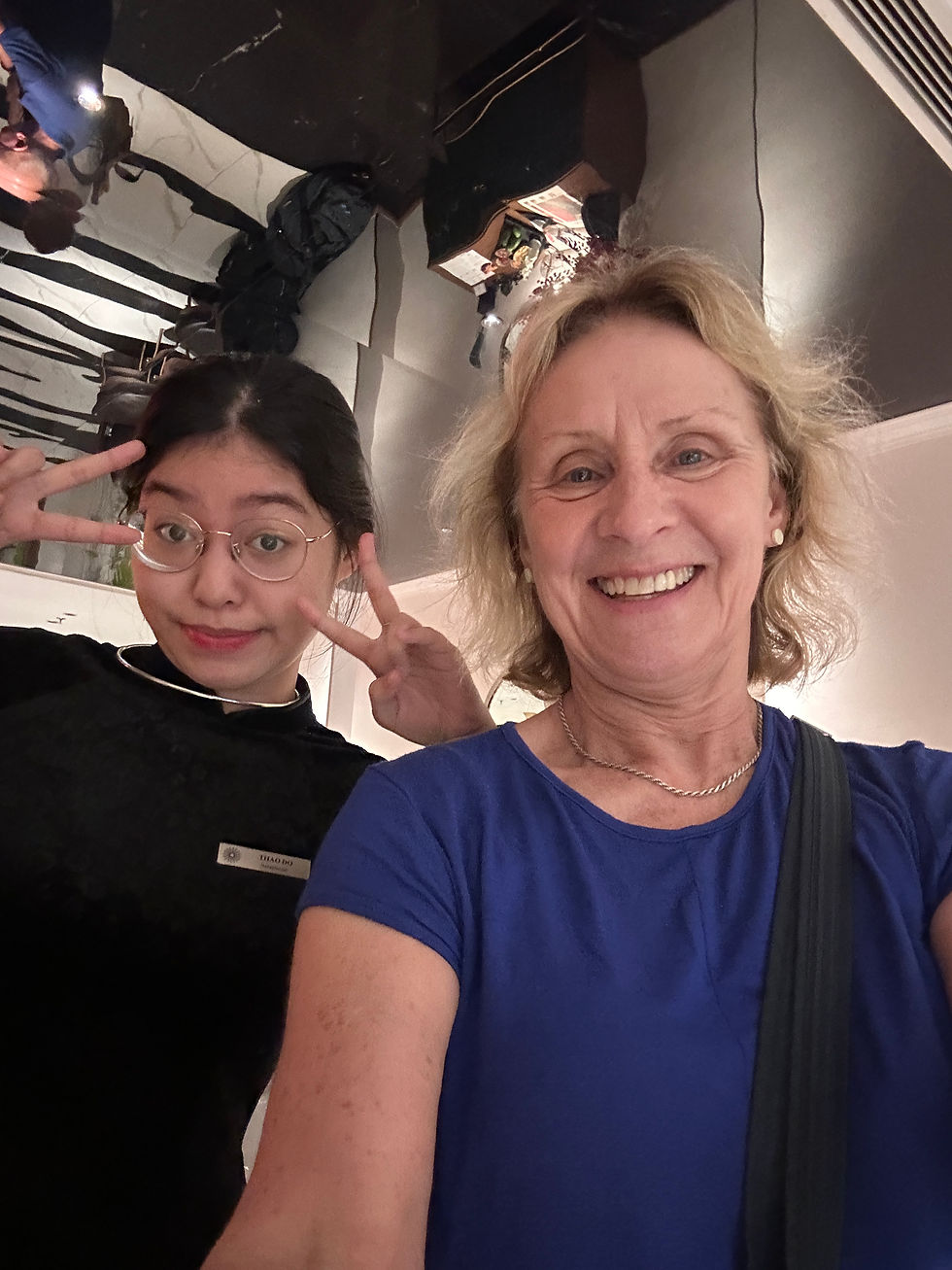
One young fellow asked us what we liked best about Hanoi, and we said the atmospheric chaos and the energy of the young people (the 20 to 30 year olds) who were smart, dressed well, and hustled at their jobs. Our favourite hotel worker Thao is one of those people, and she told me that her generation learned to work hard from a young age.
In the early morning of our first day, we strolled around the nearby lake, Hoan Kiem Lake, which seemed to be a time for the ladies as we saw many having tea together or practicing tai chi by the lake. The Ngoc Son Temple, reached by the stunning red Huc Bridge or “Place of Morning Sunlight” on an ‘islet’, is a sight. In the early morning, the lake walk was tranquil, but when we returned on a Sunday afternoon, the lakeside path was packed with local families. Here’s some calm early morning vibes before the rush begins.
Before we began our organized tours, we had two important tasks - find some Vietnam Dong (money) and try our first egg coffee. Finding Vietnam Dong was not easy. We joined other travellers going from ATM to ATM, but there was no money available in any of them - and these were big banks. Then we tried an ATM of the BIDV bank right across the street from our hotel and were able to withdraw all that we wanted.
Finding egg coffee was much easier, and we soon learned that this treat is purely addictive. But I’m not going to talk about it here; egg coffee is so good, it deserves its own write-up which you can read in my blog “Our Asian Adventure 2026: you never forget your first time (drinking egg coffee in Hanoi, Vietnam)”.

On our first day, we enjoyed the company of two lovely, energetic young adults, Ming and Summi, as we joined a half day tour by old Russian army jeep to see some ‘smaller’ sights.

They first took us to Hung Ben which is obviously one of their favourite cafes for a traditional and delicious Vietnamese lunch. Interestingly, it was beside Truc Bach Lake where the famous John McCain landed and was taken prisoner before serving five and a half years in Hanoi’s prisoner of war camp.
Ming, the very skilled young driver, then maneuvered us to what is known as Banana Island (or Bai Giura), a lush island in the middle of the Red River under the Long Bien Bridge. Although it is considered an oasis in hectic Hanoi, our guide Summi told us that not many locals come here. The island has rich vegetation and is known for banana plantations and farms. A small group of people live in very small, humble houses, away from the bustle of the rest of the city. There is also a houseboat village under the bridge. Besides learning of a ‘different’ way of life in Hanoi, it was great fun driving through the narrow, overgrown lanes in an old army jeep.
We stopped under the 2.4 kilometre Long Bien bridge which was built between 1899 and 1902 by two French architects and was once one of the longest bridges in Asia. It was important during the Vietnamese War as it was the only bridge connecting the main city of Hanoi and the port, so it was heavily bombed. It has now been converted to a motorcycle and bicycle-only bridge while a modern bridge sits in the distance. The bridge has two one-way lanes divided by a train track. The Long Bien bridge is a known site for wedding photos, sunsets and, I imagine, any manner of social media posts. To go with the history, Summi pointed out nude bathers in the river below and said this is a ‘thing to do’ on Banana Island.
Our new young friends then took us for a real treat - Hanoi Train Street. Here, we sat on little chairs outside a cafe waiting for a train to pass right outside the cafes and shops. Similar to the train market in Bangkok (if you are interested, please see my blog “Our Asia Adventure 2026: Bangkok - let a private guide handle the chaos”), the train passes right through a residential and commercial area - but this train passes even closer. Right before the train passes, young fellows hustle people off the track and push them back far enough so their faces aren’t smooshed against the side of the train. They knew exactly how much space to give the train. It was still eery. To give you some idea, the street was closed to tourists for a period in 2019 because of too many ‘close calls’. It was reopened to tourists in 2023. Now, cafe workers appear to ‘monitor’ the track. You are expected to buy a drink if you want to sit in one of the chairs, and the young fellows will save you from probable harm. The original train track was built in 1902 for trains running north. In the residential area, locals visit and play games on the track until the train arrives.
Just like everyone else, we had to use the tracks for posing before the train came:

While we waited, we were treated to a traditional Vietnamese dessert, banh com, made from rice and mung bean, and an egg coffee until the young cafe worker almost literally pushed us backwards away from the approaching train. So much fun.
And then the train came:

As my travelling companion Bev said, “with some beer (at lunch), two egg coffees, and a near-death experience (the train)”, we were “good to go”. To finish the day, we visited the B52 museum, and it seemed fitting to pull up in our old army jeep that sputtered to life only after Ming pumped the gas several times.
The B52 bomber plane was used by the United States during the Vietnam War, particularly during 12 days known as Operation Linebacker in December 1972. The Vietnamese used Soviet-supplied missiles to bring down many B52’s, the number differs depending on which side you listen to. There is much written on line about the role of B52’s and Operation Linebacker in the Vietnam War from the perspective of the war intensifying to the resilience of the Vietnamese to whether or not the B52 bombings in December 1972 helped to resume peace talks. Regardless, the B52 is almost a symbol of the Vietnam War.
Looking at the wreckage of the B52 at the museum, all I can say is that war is brutal, very brutal.
Despite the sombreness of the B52 museum, we had such an enjoyable day with Ming and Summi. Their energy was contagious.
Our second day in Hanoi was much more serious. We had hired a private guide for a full day tour to see some main sights, informative but not nearly as much fun as our outing with our young friends.
Our first early morning stop was the Tran Quac Pagoda, described as one of the unmissable sights in Hanoi. It is some 1,500 years old, the oldest in Hanoi. It sits beautifully on an ‘islet’ in Westlake. Its centrepiece is the 11 story stupa, or tower, each story made of six arched doorways holding a Buddha figure. Reading up, there is a difference between pagodas and temples. Pagodas are described as a place for spiritual peace and reflection while temples are more for worshiping or remembering ancient kings and local heros. A good explanation of the difference can be found at “Temples vs Pagodas: Spiritual Heart of Vietnamese Culture” at hanoifreeprivatetourguide.com. In Sing’s explanation, the difference between a Buddhist pagoda and a temple is that a pagoda is a place for everyone to ask for blessings for general wellbeing whereas a temple is a place for more specific requests such as wealth. This was a truly beautiful site with endless photo angles.

The surrounding buildings are for contemplation, intention, and understanding.
Sing then escorted us to the most important site for the Vietnamese, the Ho Chi Minh Memorial in Ba Dinh Square. Ho Chi Minh is seen as the father of Vietnam, their most influential leader who facilitated revolution and liberation. Again, there is much on line if you want to know more about Ho Chi Minh. He certainly has an interesting background with, of course, some who dispute his accomplishments and/or methods. The memorial has limited opening days and hours so I imagine lineups are a given. But what a lineup! In addition to locals and tourists and a string of ‘important people’, there were hundreds (thousands?) of elementary-aged school children lining up to see the embalmed body of Ho Chi Minh. Although we found it strange to parade school children before a dead body, Sing explained that this was seen as almost a rite of passage. Children are taught from a young age that Ho Chi Minh was the most important figure in Vietnamese history, so to visit his body was an anticipated honour. They were bouncing up and down and waving and giving us “high-fives”; one gave us the ‘thumbs up’ when we said we were from Canada. Of course, no pictures were allowed of the embalmed body of Ho Chi Minh.
Outside the Ho Chi Minh memorial was the delightful and picturesque One Pillar Pagoda, or ‘lotus pedestal’, a pagoda built on, well, one pillar. The One Pillar Pagoda originated in 1049 and was revamped in 1104. As with most temples or pagodas, there is a story attached about an emperor who dreamed he was handed a baby son by a compassionate Buddha sitting on a lotus flower. He then married a peasant girl, and they gave birth to a baby son. He built the temple in gratitude. The temple is four metres high and resembles a lotus blossom. It is one of Hanoi’s iconic temples, and the photo ops are endless with the water ‘moat’ and floating lotus blossoms. The lotus flower is a Buddhist symbol of purity.
Adjacent to the One Pillar Pagoda:
Next up was a bit of Vietnam artistic culture, the historic art of lacquerware which dates back some 2,000 years. We visited a studio/sales outlet where we learned how a surface is carefully prepped over several stages and then painted or painstakingly designed with tiny egg shells or silver or gold to create elaborate scenes which are then coated with lacquer tree sap into a hard picture or bowl. The results were beautiful, and if we would have had larger suitcases, we would have purchased a whimsical scene. A good article is “Southern lacquer villages struggle to survive” at en.vietnamplus.vn which talks about the history of lacquerware and the struggle of small rural villages to preserve their craft. Other historic crafts include pottery, silk and bamboo weaving, wood carving, and bronze work.
Our fourth stop was Hanoi’s most prestigious temple, the Temple of Literature. It was built in 1070 to worship Confucius and housed the first university, the Imperial Academy. Many renowned scholars attended. The grounds are beautiful, the architecture is grand, and it is a serene sanctuary amidst the crowds of Hanoi. You walk through several gates and courtyards to reach Confucius. Many students still come to the temple to pray for good marks.
The main gate:
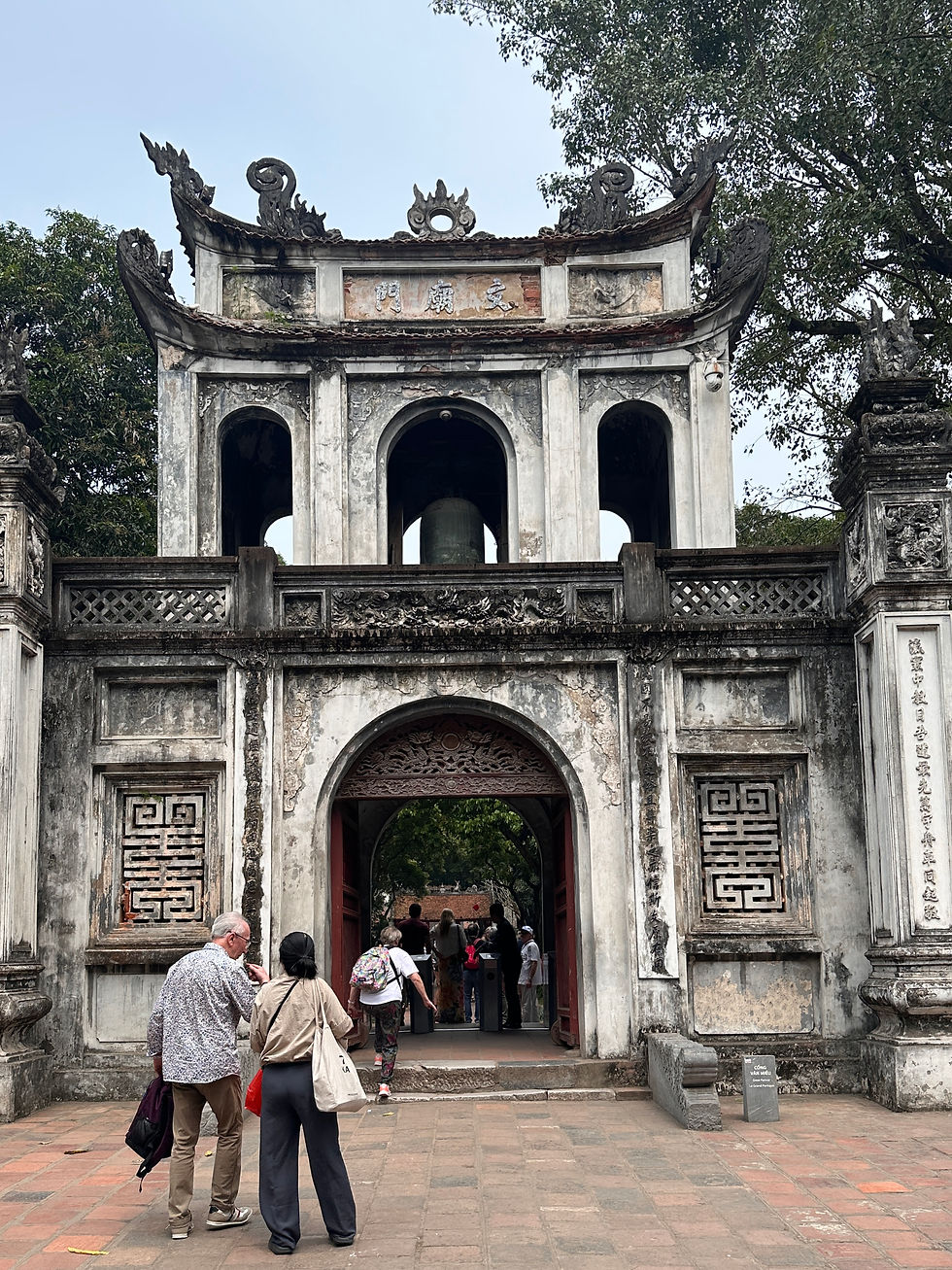
The Great Middle Gate:
Khue Van Pavillion front and back:
The Gate Of Great Synthesis:

And, finally, Confucius:
I liked the 82 stone turtle statues at the Temple of Literature honouring over 1,300 doctoral graduates whose names are inscribed on wooden slabs attached to the shell of the turtles. Turtles represent wisdom and longevity and symbolize Vietnam’s commitment to learning. (You used to be able to rub a turtle’s head, but no more due to a protective fence.)

I particularly liked the creative display in the final pavilion. The Temple of Literature is a symbol of knowledge and creativity, and this pavilion houses an exhibition that combines contemporary art with traditional heritage values. The current works are inspired by festivals of the ancient capital.
At this point, our heads were swimming with information and lineups, but we were in for a real taste-fest, the best food of our Asian adventure thus far. When Barack Obama visited Vietnam in 2016, he had lunch at a little unassuming and unknown cafe, Huong Lien, and now the cafe is famous. We arrived after the lunch hour but the cafe was still packed. Sing told us that at noon, the lineups string down the street. I believe we had the same meal and beer that President Obama had, and it was amazing. The restaurant and menu have not changed one bit - unassuming and cramped.
If you know me, you know I was really looking forward to our next stop, the Hoa Lo Prison or ‘Hanoi Hilton’ as it came to be known to American prisoners, as this is where the famous John McCain spent five and a half years of his life. The prison was built by the French between 1896 and 1901 and had a long history of housing political prisoners with overcrowding and inhumane conditions. When the French left Vietnam in 1954, the prison was taken over by the Vietnam government. The first American prisoners of war arrived in 1964. The museum presented that American prisoners were given many benefits and comforts and, reading up, it is agreed that conditions did improve several years after the first Americans arrived but it is strongly implied that until that time, American prisoners were subjected to torture, harsh treatment, and squalid conditions. You might want to research this yourself and form your own opinions.
I did not get many pictures of the prison, but I thought this panorama of the return visit of several American prisoners was interesting. John McCain is generally seen as the face of reconciliation and friendship between America and Vietnam.

As an interesting aside, if you’d like a bit of psychology, look up the Stockdale Paradox named after US Admiral James Stockdale who served eight years in Hoa Lo Prison. The study looked into how certain prisoners survive harsh conditions while others perish. The ‘solution’ is apparently an unwavering belief that you will endure while also being realistic about the harsh conditions. It’s a good life lesson.
We ended the day with a bit of fun - a rickshaw tour of old town Hanoi, dodging cars, motorcycles, people, busses, vans, and roadside sellers. We determined that rickshaws ‘sort of’, maybe, have the right of way, but we cannot confirm. It was a great opportunity for picture-taking. Again, we had an energetic young person keeping us safe in the chaos. Notice the picture of Bev checking to see if we are following (or still alive).
One of the ‘things to do’ when you visit Hanoi is take a side trip to Ha Long Bay, about a three hour drive away, and I do recommend. Ha Long Bay and the Cat Ba Archipelgo covers 65,650 hectares and is known for the 1,133 limestone ‘islands’ rising jaggedly from the sea. It’s a UNESCO site, and you’ve probably seen pictures in advertisements for Vietnam. UNESCO states that the Ha Long Bay is one of the most important areas for “conical peaks, “tower features” and “ecosystems”. A good article explaining the beauty and importance of this natural masterpiece is “Ha Long Bay - Cat Ba Archipelago” at whc.unesco.org. The article also talks about the efforts to manage and protect this area while still making it accessible to travellers.
Our hotel arranged a one-night cruise with Orchid Cruises, but there are many cruise companies available as you will see by all the tour company vans on your drive to the bay.
Ha Long Bay is beautiful and unique. Although the bay is crowded with tour boats, it does not distract from the atmosphere. We slowly cruised around the limestone peaks. The photo ops are endless here.
Our boat had several activities, if you chose. Travelling partner Harvey and I kayaked around a bay, one of those ‘special moments’.

We were taught how to make spring rolls by our high-energy host and then tried our hand. We were pretty impressed with ourselves.
Cousin Ron’s friend, and our travelling partner for this portion of our trip, Carol, and I joined a tour to the Trung Trang Cave in the Cat Ba National Park on Cat Ba Island, a short boat and bus ride from our cruise boat. The Cat Ba National Park is a UNESCO-recognized natural area of forests, caves, and mangroves. It’s known for plant and animal species. The name Cat Ba means Women’s Island. There are two possible legends behind this name. One is that three women of the Tran Dynasty were murdered and when they washed up on shore, local fisherman erected temples in their honour. The other is that women held the place together while their men fought in the war. Take your pick of legend. At another time, this might be a great place to explore.
Trung Trang is the largest cave and was discovered by the French in 1938. It stretches 300 metres, and the photo ops were endless with the different rock formations and stalactites. It’s also known as ‘bat cave’ for obvious reasons, but we did not see any little hairy creatures. We had to crouch really low in some places - not for the claustrophobic.
Our room, the food, and the atmosphere on the cruise boat were just right. The cruise staff arranged a lovely honeymoon celebration for a young Austrian couple. One night was a perfect amount of time to enjoy Ha Long Bay, although other ‘packages’ would give time to visit islands and go hiking or biking which also sounds enticing.

The signature meal was amazing:
On our drive to and from Ha Long Bay, we were able to see some of Northern Vietnam’s most productive farmland, perfect for rice and vegetables.
Ha Long Bay is also known for pearl farming, and we stopped for a break at a roadside service stop which specializes in pearl jewellery sales and had the most amazing selection. Once you get in, you are caught in a maze that winds itself around and around display case after display case. I do love pearls but . . .
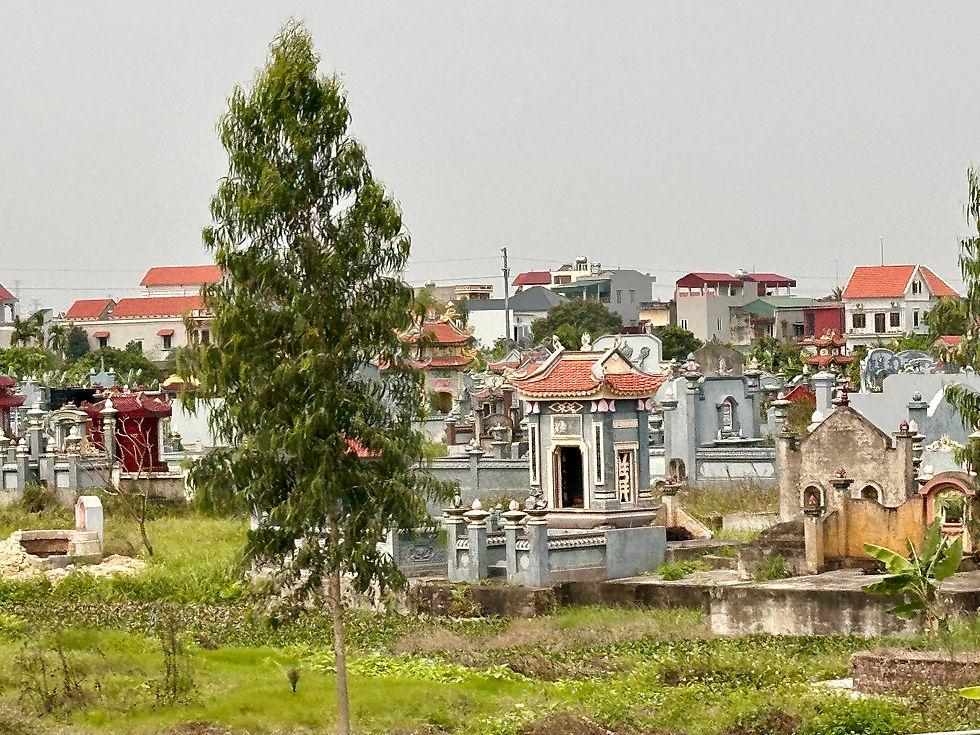
We were quite fascinated by the cemeteries or simple gravestones right in the middle of rice fields. This is worth researching. Short story - families who wish to keep their ancestors close and perhaps prohibit the sales of their farmland bury their deceased in the rice field. In some places, bodies are exhumed for reburial after three years, but some are left permanently to maintain a connection between the living and the deceased.
We had no set plans for our last day in Hanoi. Bev and I treated ourselves to a spa day at our La Siesta Classic hotel, a full body hot oil/hot stone massage and rejuvenating facial. It was so refreshing after a couple of weeks ‘on the road’. Hanoi has an abundance of hotels to choose from depending on your wishes.

At noon, we tried a classic Banh Mi ‘sub’ from a tiny sidewalk cafe. It turned out to be the first of many. You could go on a hunt for the best Banh Mi in Vietnam.
We then went on a little walk-about around central Hanoi. Old town is jam-packed with street after street of little shops and tall, narrow hotels - and people, being it was Sunday. The highlight was Book Street where people can sit and read in peace and quiet at several little nooks. There was no one there when we visited as the book sellers are closed on Sunday; and the rain provided some fun photos. This is a brilliant idea in a somewhat overwhelming city.
We ended our day, of course, with a final egg coffee at our favourite, Hanoi Coffee Culture 1956. Yes, I achieved coffee nirvana in Hanoi.
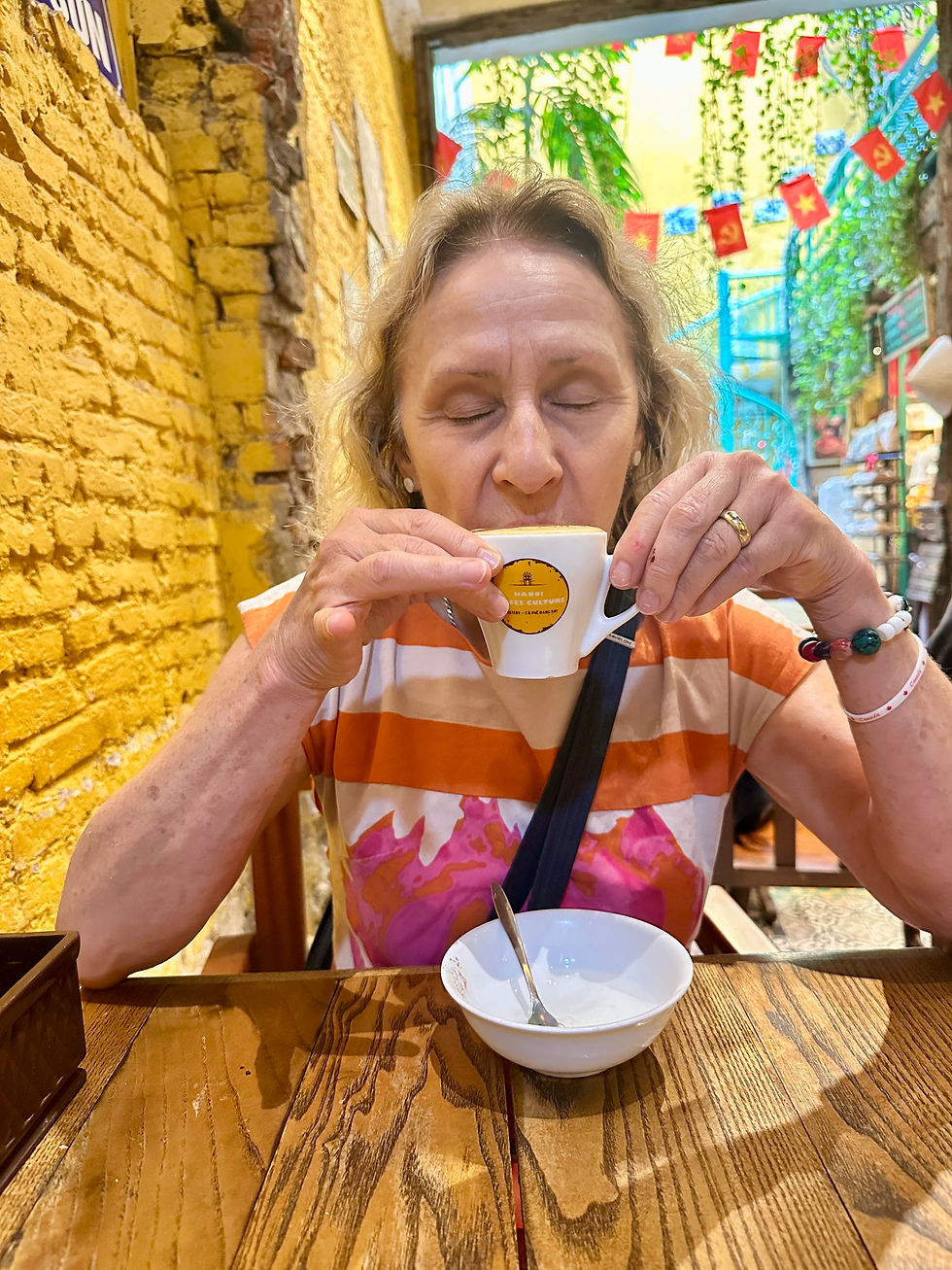
That ended our week in Hanoi. Looking back, we saw and experienced a lot more than I had initially thought from a bit of history to off-the-beaten-track to amazing scenery to chaotic ambience to delicious food . . . and that coffee! But I feel I was just becoming familiar with this city and would have liked a couple more days to visit some parks and museums and famous buildings. Always leave something for next time . . .
One final good bye to our favourite hotel employee who made our stay extra special:

We are now on our way to Hoi Ann which will be a seriously slower change of pace.
Thanks for reading.
Enjoy this photo collage:


Comments