


Quito, Ecuador - thin air and the finest chocolate brownie in the world’s second highest (or is that the highest?) capital

Quite frankly, we knew nothing about Quito, Ecuador. It just seemed like a logical stop on our way to Peru. But this city will stay with me forever. I’d describe it as modern but humble, confident but not cocky. It is a forward-looking city with deep indigenous and geographical roots.
Quito is high, very high up in the Andes of Ecuador at 2,850 metres on the eastern slopes of the Pichincha Volcano. The only way to describe the terrain is dramatic. Quito is the world’s second highest capital city, or it might be the highest depending on who you ask. La Paz, the administrative capital of Bolivia, is higher at 3,650 metres, but the constitutional capital of Bolivia is actually Sucre at a mere 2,790 metres. Let’s not argue, though, most people will feel Quito’s 2,850 metres as they slowly manoeuvre up the steep slopes and winding streets and roads along with 2.8 million residents. After four days, I was still breathing heavily up those hills.
That terrain and population, along with the fact that Quito extends over 50 kilometres down a narrow valley flanked by volcanoes, are all the more reasons to hire a private guide, if you are able. (If you read my blog, you know I am a fan of private guides for their convenience, knowledge, and willingness to tailor the trip to your liking.) An online search for “best private guide” in Quito directed us to Marco Herrera, a licensed operator with years of experience and his own vehicle. This was a great decision and made experiencing this city enjoyable. He is smart, kind, and humourous. You can find him at https://www.marcohh.com/english-version.

That terrain makes for some great photos from several viewpoints throughout the city.


First, though, where to stay? There are lots of options from small boutique lodgings to massive business hotels. We chose a new hotel, the GoQuito in the business section of Quito known for its eco-friendly design, food, accommodation, and service (especially when I got sick - from food intolerance or altitude, or a combination - and they were giving me ginger ale, a special ginger concoction, lemon juice, and later tea and coffee) - and one of the best rooftop breakfast buffet views in Quito. There’s a reason this hotel was named South America’s Leading New Hotel in 2025. But you definitely don’t need to book a large hotel - there are many affordable options in this very affordable city.
High above Quito, the statue of the Virgin Mary (Virgen de el Panecillo) stands watch from the El Panecillo Hill viewpoint, one of the best views of the city. Quito can also boast about the size of this statue. It is apparently higher at 41 metres than the Christ the Redeemer statue at about 38 metres in Rio de Janeiro and is the tallest aluminum statue in the world, made in Spain of over 7,000 pieces of aluminum which were then shipped to Quito for assembly. That would be quite the fun project with each piece numbered for assembly.
But I particularly loved the nearby modern statue of a black woman dancing against the city backdrop and next to the La Ola (The Wave) statue which is aimed at bringing art out of the museums and to the people. It seemed like a good metaphor for Quito - free, contented, and happy with life. Whichever statue you like best, they are both an ode to women everywhere.
Quito’s old town is historically significant as it was the first old town to be named by UNESCO as a Cultural Heritage site in 1978. It is the largest and best preserved old town in South America. If you’d like, you can read up at City of Quito - UNESCO World Heritage Centre to learn more about how the architecture and incorporation with the rugged landscape helped to earn it’s designation. Narrow streets (some pedestrian-only) wind through colorful houses, historic squares, churches, and museums. It is a very pleasant old town, indeed.
One of the most historic, popular, and photogenic pedestrian streets in old town is Calle de La Ronda (or Calle Juan de Dios Morales) with its colorful facades, cafes, and artisans. Historically, it was an ancient Inca trail used to fetch water. It later attracted artists, musicians, and writers. There are plenty of good photo ops on Calle Ronda and the surrounding streets.
Quito’s old town is home to some magnificent churches and monasteries, but with literally dozens to choose from, you certainly can’t visit them all in one day. We visited two and received a good taste of the European Spanish architecture and traditional indigenous art that combined to make Quito’s churches famous.
The Iglesia de la Compania de Jesus is known as the most famous and opulent and is worth the $6.00 entry fee. It dates to the 1600’s and is said to be “the pinnacle of Latin American Baroque Art” with “every inch” gilded with fine 23 carat gold leaf, according to the Fundacion Iglesia de la Compania de Jesus. (Sorry, sister-in-law Bev, this is one of the finest churches we have visited.)
The El Sagrario Church also dates to the 1600’s. It might not look dramatic from the outside, but the inside is spectacular with an ornate gold-gilded alter and painted fresco dome. It is a work of art.
As soon as you step off the plane, you notice something - after the thinning air, of course. If you said ‘chocolate’, you are right. There are pictures and signs for chocolate and chocolate tours and chocolate tastings everywhere. A little research revealed that Ecuador is the birthplace of chocolate and the world leader in the production of cacao, the key ingredient in making fine chocolate. What a serendipitous happening for someone who believes that chocolate is one of the five main food groups. I recommend the article ‘How Ecuador is falling back in love with chocolate’ by Jez Fredenburgh at nationalgeographic.com where you can learn about the finesse of chocolate-making. Fine chocolate is an art, indeed. Legend has it that when the Spaniards arrived many centuries ago, they found chests of, not gold, but chocolate. True or not, chocolate exports soon played a large role in Ecuador’s economy.
So, strolling old town Quito, across from the beautiful Iglesia de San Francisco Quito, we entered chocolate heaven, Yumbos Chocolate Artesenal, where ‘Michael’ briefed us about Ecuador’s cacao production and lead us in a tasting of 13 (yes, 13) flavours of chocolate from straight cacao to flavours of orange, ginger, salt . . . but then the ‘piece de resistance’ - their signature brownie and a cup of cocoa made from straight cacao and milk. Brownies are apparently another art in Quito, and Michael informed that Yumbos has won ‘best brownie’ in Quito. I cannot confirm as I suspect many bakers claim to make the ‘best brownie’, but I will definitely not argue that fact. It was the BEST brownie, ever.

Iglesia de San Francisco Quito
Chocolate heaven:
The centrepiece of Quito’s old town is the Plaza de la Indepencia (Independence Square) or Plaza Grande as it is known representing Ecuador’s independence from the Spanish in the early 1800’s. The plaza is overlooked by the Independence Monument or the Figure of Liberty; and the plaza is surrounded by Carondelet Palace, the Metropolitan Cathedral, the Archbishop's Palace, the Municipal Palace and the Plaza Grande Hotel. It is definitely a pleasant spot to ponder life or people-watch.
While strolling the streets of old town, it became evident that sweets are popular in Ecuador. We just had to sample two ball-shaped candies, one fig and one coconut. So delicious. We learned that one of the most treasured delicacies is figs simmered slowly in a sweet, spicy syrup.

On our way back to Marco’s car from old town (he’s an amazing driver, by the way), we stopped at the Teatro Bolivar or Bolivar Theatre. It’s an iconic art deco building dating to 1933 and restored after a fire in 1999. It has over 2,000 seats and has hosted world- known acts such as the New York Philharmonic Orchestra. I can just imagine a live performance here.
Did you know that Quito sits about 12 miles south of the equator, so close that a short drive takes you to the Mitad del Mundo (middle of the world). Quito has done a great job celebrating this fact in a fun but educational museum, the Museo Solar Intinan, where students and adults can learn about the indigenous tribes living on the equatorial line and how that location affected their beliefs and their customs; and through a fun tour, you can learn about the quirks of the equator. For instance, it is virtually impossible to walk the equator line, eyes closed, without stumbling, but if you hold yourself just right, you can balance an egg on a nail. Or did you know that water swirls down a drain in a different direction depending on which side of the equator the drain is on?
Learning about indigenous peoples:
Middle of the earth and a perfectly tuned sundial:
It might be impossible to walk a straight line on the equator:
The Ciudad Mitad del Mundo is a popular amusement and cultural park built around a 30-metre high stone monument and painted yellow line where you can snap great photos straddling the equator. . . but modern GPS shows that the actual equator is about 200 metres away at the Museo Solar Intinan. Although this is a touristic park, I can see families spending an enjoyable day here checking out the monument, a traditional church, an indigenous village, a beer garden, an arena which was once a bull fighting ring, interactive displays, etc.

Traditional indigenous thatched homes:
Straddling the equator:

You could even sample Guinea pig, or ‘cuy’. What might be a pet in North America is reserved as a delicacy for special occasions in Ecuador. Marco advised the taste is similar to rabbit.

A beautiful little restored church where marriages, baptisms, and confirmations were held to honour ancient traditions of those living on the equatorial line:
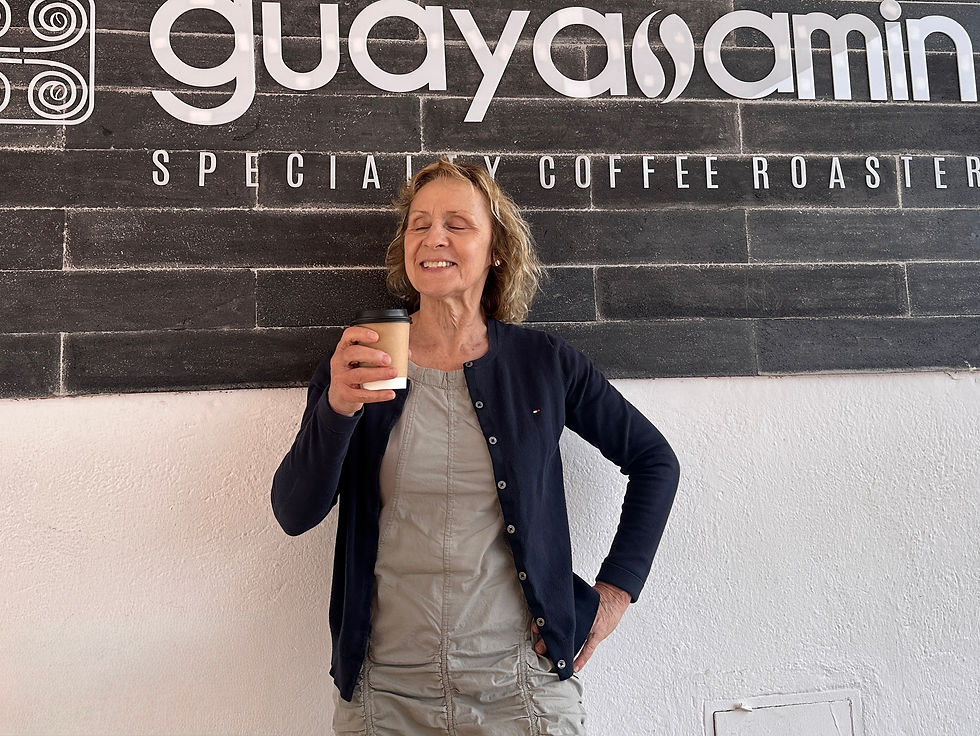
It was at the Ciudad del Mundo where we happened upon coffee that was voted one of the 100 best coffees in South America. Agreed. (I thought of you, friend Tracy.)
Nearby is the delightful town, or parish, of Calacali, important for its history of indigenous people and for being the gateway to cloud forests and geobotanical reserves. The equator runs right through the town, and there is a traditional monument marking the centre of the world in the town square (it’s a much quieter monument than the more commercial Museo Solar Intinan or Ciudad Mitad del Mundo). The church, Iglesia de Santa Maria Magdalena, sits on the town square with a carved water fountain dating to the 1600’s in front. The area of Calacali was inhabited by pre-Hispanic peoples, the Yumbo, between 800 and 1600 AD. I loved strolling the streets of this authentic Ecuadoran village.
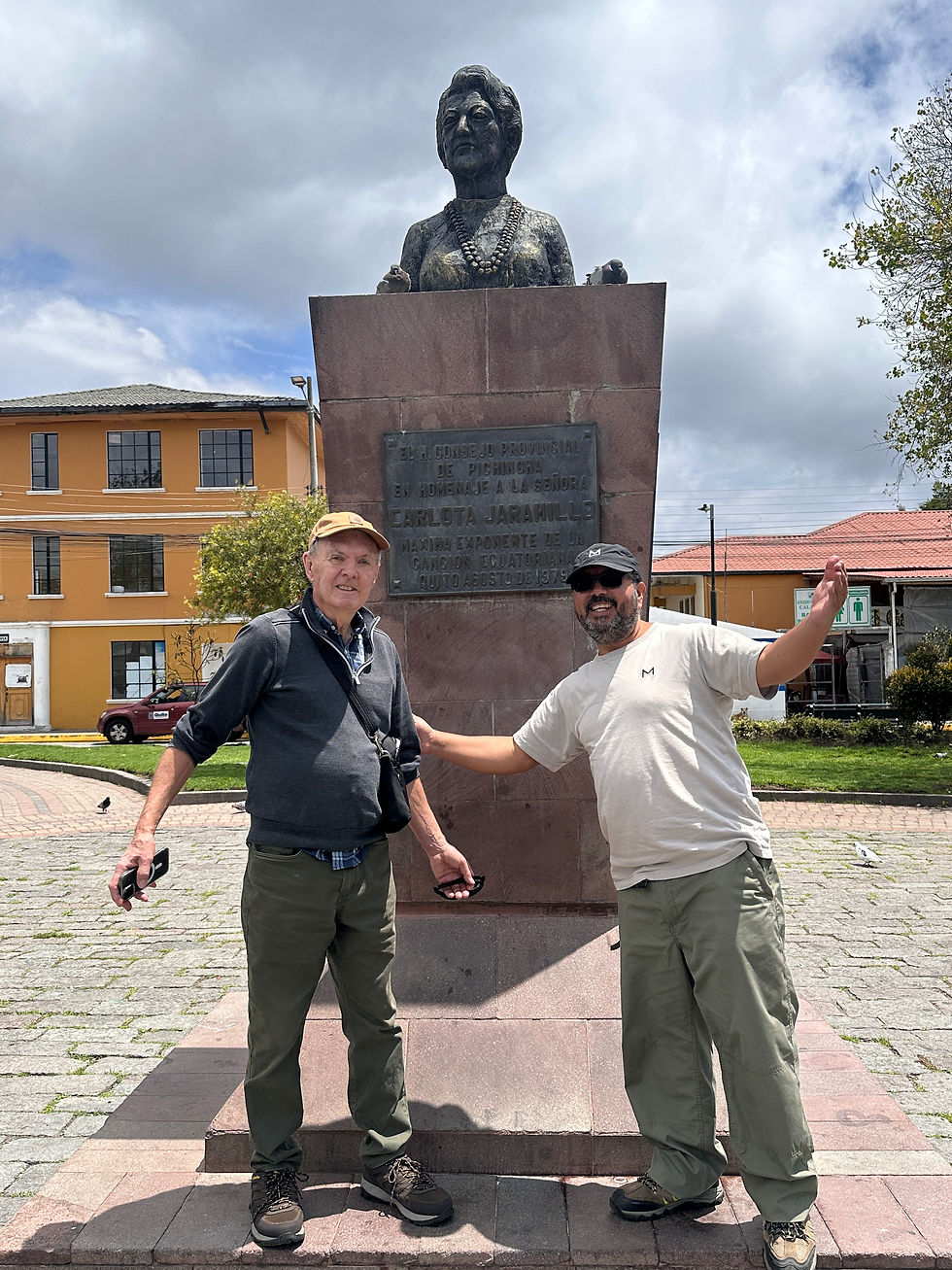
Calacali was home to one of Ecuador’s most famous singers, Carlota Jaramillo. Larry and Marco had to have a picture with her statue.
It’s difficult to pinpoint exactly how many volcanoes exist in Ecuador, but estimates are upwards of 40 in the country and up to 17 around the Quito area, many extinct. Suffice it to say, that means wonderful valleys formed centuries ago when volcanoes erupted. We stopped at Reserva Geobotanica Pululahua, right next to Calacali, where the views were magnificent. The valley floor is fertile, perfect for small farms. This is one of the few inhabited volcano craters in the world. If we had been more acclimatized to the altitude, I would have loved to hike to the valley below (but then you have to hike back up . . . ).

Given its location so close to the equator with 12 hours of sun daily, plenty of rain, and mountainous terrain, you can be in a cloud forest in under an hour. From Calacali, Marco skilfully maneuvered us up a tight winding road to the Reserva Alambi, or hummingbird paradise as they call it, known as the best spot for hummingbirds with over 30 species fluttering around and feeding at the many feeders. This spot is one of the best for nature photographers due to the number of species and perfect lighting. (There were some pretty big cameras set up.)
There are several traditional markets in Quito. We visited La Carolina where we saw an array of fruits, vegetables, medicinal herbs, meat, and fish. The smells and sights and photo ops were endless.
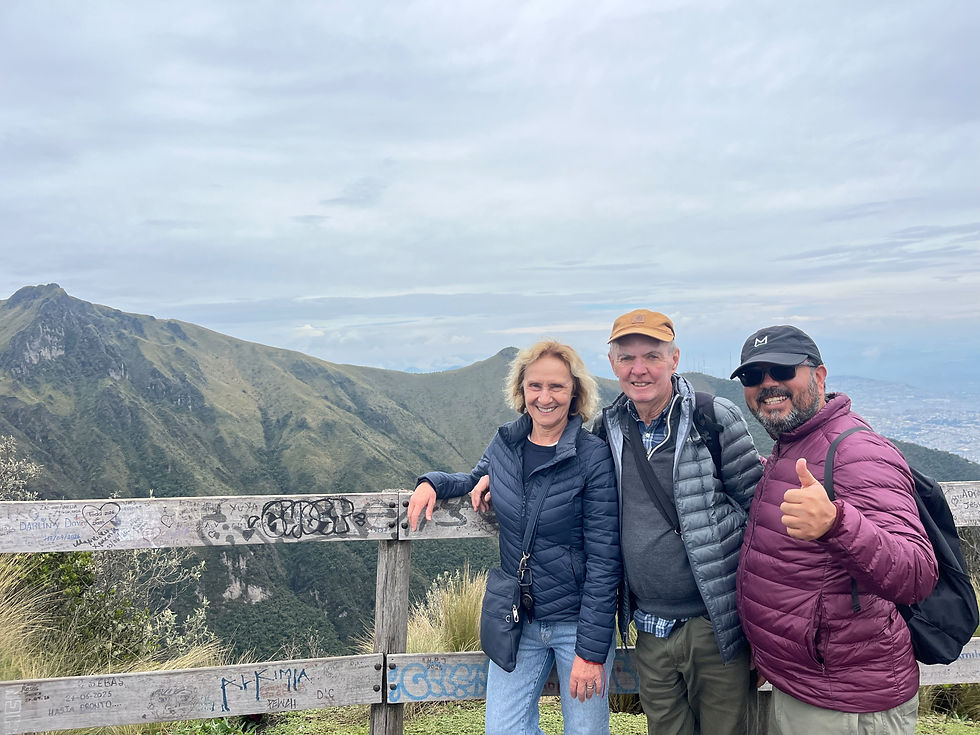
One of the ‘must-do’s’ in Quito is to ride the cable car TeleferiQo, one of the highest in the world, taking you almost 13,000 feet up the eastern side of the Pichincha Volcano. The view and hikes at the top are spectacular with mountains, valleys, and the city spreading below. We strolled (literally, due to the altitude) to the Cruz Loma summit to the Columpio en las Nubes, or Swing in the Clouds. Yes, it might be touristy, but it was such fun playing and getting the perfect optical illusion shot swinging over Quito. It might be the best photo of the city. Again, if we had been acclimatized to the altitude, I would have loved one of the higher hikes up the Pichincha Volcano, over 15,000 feet. You could also paraglide, mountain bike, or horse ride. This area is breathtaking in more ways than one.
There are at least 40 museums in Quito, maybe more depending on how you consider cultural centres, galleries, and such. We visited the Casa Museo Guayasamin, a private museum in the home of Ecuador’s now-deceased renowned artist, Oswaldo Guayasamin. Born into poverty and later becoming very wealthy, his works display a concern for, and understanding of, the human condition. Some of his themes were indigenous roots, anger, tenderness, and human rights. It is both beautiful and emotional. This was definitely a highlight of our visit to Quito.

Outside sculptures:
I loved his studio:

He designed the house himself. Stunning.
Here’s just a small sample of his amazing, heartfelt work:
One thing we like to do in a new city is visit a university campus. Marco took us to his alma mater, the Universidad Central del Ecuador, the Central University of Ecuador, and specifically to the faculty of humanities. Serendipitously, the first person we met was a professor who has taught at the university for 37 years, including the years that Marco attended. He pointed us to the Museo Antropologico where we were given a personal tour explaining the research the faculty was doing into indigenous peoples and the meanings and context of their lifestyles - and more insight into what influenced Ecuador into the country it is today. This is probably a little-known museum, and I felt it was a privilege to be given a private tour. (We smiled because the professor with tenure practically pushed us into the museum.)
That completed our four days in Quito, Ecuador. I will never forget this city. Hire a private guide like Marco and you can do all of these things. There is plenty to see and do here in arts and history and culture and adventure, or it would be a great jumping off spot for eco-tours to the forests and Galápagos Islands or to do a deep dive into South American indigenous cultures. But whatever you choose, walk slowly until you are acclimatized and don’t miss the chocolate brownies.
I hope you enjoyed this little view of Quito. I try to be accurate, but always do your own research.
As with any country, Ecuador has It’s issues, so travel safely and wisely. Organized drug and gang conflicts are a large issue, and some border and coastal towns remain under “do not travel” status. Enjoy the main sights, stay in a safe location, use travel-safe bags, avoid sketchy areas, don’t alter your mind with alcohol and drugs, be aware of your surroundings and, at our age, just return to the hotel early for a nice long evening. Private guides or tour companies make travel that much safer.
Enjoy this final photo collage.


Comments