


Our SE Asia Adventure 2026: Luang Prabang, Laos - respect the diversity (and be sure to buy some Laotian Kip for those deep-fried bananas)
Updated: Apr 8

After our four days in hectic Bangkok, Thailand, we hopped a short 1.5 hour flight to Luang Prabang, Laos, where it’s a whole other world, as they say. It’s a small city of about 40,000 in the northern region of Laos.
Laos experienced a civil war between the government and the communist party between 1959 and 1975. I am not a historian, and wars are complicated with competing vested interests, so I urge you to do your own research. It is known that Laos was one of the most bombed countries per capita in history, decimating towns and villages and leaving many unexploded ordnances. One informative article is ‘Laos During The Vietnam War’ by J. Llewellyn, et al, at alpha history.com. Suffice it to say, it takes a long time for a country to ‘right itself’.
There is much online about Laos’ economy and the efforts to improve the overall standard of living. The goal is to move out of the Least Developed Country status in 2026 and become sustainable by 2030 (if you wish, refer to ‘The National Assembly and United Nations Partners Launch Policy Dialogue on Lao PDR’s 10th National Socio-Economic Development Plan (2026–2030)’ at undp.org). The plan focuses on “economic diversification and quality growth, human capital development and poverty reduction, climate resilience and environmental sustainability”. I can say that the difference in living standards between the developed areas of the small city of Luang Prabang and the remote areas is stark.
In 2016, President Obama visited Luang Prabang to forge a new working relationship with Laos and also to commit funds to restore the country, especially in light of the USA’s role in the Laotian war. Some of the funds were to clear undetonated landmines and some were for community development. For more, read ‘Fact Sheet: U.S.-Laos relations’ at presidency.ucsb.edu. (By the way, President Obama is the only US president to visit Laos. He enjoyed a coconut outside a restaurant in Luang Prabang, making the restaurant famous.)

Tourism is the main force in Luang Prabang (I would say by far - our tour guide estimates up to 90% of the economy is tourism-based), helping the city to reduce poverty levels and raise the overall standard of living in the area. It was granted UNESCO status in 1995 for its well-preserved blend of traditional architecture and buildings constructed by Europeans in the 19th and 20th century. (‘Town of Luang Prabang’ at who.unesco.org). Even at the end of the high season, the streets were lined with tour company vans, but the town maintains its charming atmosphere.
Due to the French influence in Laos, there are many French colonial structures in Luang Prabang, our ‘My BanLao’ hotel being one of them. It has a rich history, previously serving as CIA Headquarters during the war. Despite being completely remodelled, you can still see the heavy protective door in the breakfast room. The grounds are immaculate with coconut, palm, and frangipani trees which bloom the national flower of Laos. The hotel takes steps towards ecology and conservation and has a turtle sanctuary on site.
I always say that I try to be accurate with information, but it is difficult with ancient history and a foreign language, so always do your own research; but I can give an important tip: Despite Luang Prabang being one of Laos’ main tourist draws, credit cards are not widely used (actually, very little) so do hit up an ATM for some Laotian Kip if you want to sample authentic food at the street stands or local markets or pretty much make any purchase. I’m still sad I had to pass up the deep-fried bananas at a street stand.
Rivers are an important part of life for Luang Prabang. The city is located on a peninsula of the Mekong and the Nam Khan River surrounded by mountains. On our first day, we experienced the mighty Mekong up close by booking a private long boat tour through Get Your Guide. The river is wide but quite low as we visited just prior to the rainy season. We were surprised at the brown colour and, unfortunately, much garbage, mostly plastics. The garbage is apparently due to the use of single-use plastic bottles, limited recycling, proximity of local waste sites, monsoon flooding, etc. This is worth reading about, and there are many articles on line. One is ‘Plastic Waste is Choking the Mekong River and Every Nation On Its Path’ by Anton L. Delgado at Saigoneer.com.
Now, having said all of that, there is plenty of good ambience floating down the Mekong in the 35 Celsius heat passing small farms, water buffalo, goats, roosters, villages, fishermen, children swimming, local ferry transports, and long boat after long boat. The Mekong is just a local thoroughfare. Note the local fisherman and the young boy carrying a huge sack.

We stopped at the Manifa Elephant Camp where we were treated to an amazing Thai meal overlooking the Mekong River and where we met and fed snacks to one of the elephants that come to the camp. That 38 year old girl sure can eat mini-bananas and was quick to nudge us if we did not give her as many as she wanted. The elephants were untethered and free to roam over the 100 hectare forest property. The Manifa Elephant Camp website explains their purpose and ethical considerations.
Our next stop was the Pak Ou caves, 24 kilometres north of Luang Prabang, about a two hour boat ride (if you don’t stop to eat with the elephants). The caves are known for hundreds of Buddha statues, small and large, that probably cover all the many recognized Buddha positions (the main four being sitting, standing, walking, and reclining) and the meaningful hand gestures. The stairs up were a true workout.
Our boat then took us to a scenic area at the confluence of the Mekong and Nam Ou Rivers where the rock cliffs were high and sheer.
It was at the meeting of the rivers that we passed a children’s library boat. There are two Book Boats run by the Luang Prabang Public Library on the Mekong and Nam Ou Rivers, carrying 1,000 books to 100 villages annually along the rivers. Such a superb idea in a country where books might not be readily available.

On our way back to Luang Prabang, we had one last stop at Ban Xiang Hai Village where they use rudimentary methods to produce rice wine and whiskey which we had the opportunity to sample. One of the two flavours of wine was palatable to me, but I did not attempt the whiskey. However, cousin Ron bought a bottle distilled with a snake inside which apparently gives it a, shall I say, ‘unique’ taste. I am quite sure cousin Ron will use it as a conversation piece as he downs our Canadian whiskey at his kitchen table?

As we returned to Luang Prabang in late afternoon, we were treated to a picture-perfect sunset courtesy of Mother Nature. The river was packed with boats waiting for the special moment. Magnificent.


In my last blog, I sang the praises of hiring a private local guide to show us some main sights but also life off the beaten path. In Luang Prabang, we used the services of Wander Laos, a highly-rated tour company in Laos. Our private guide was Chan who just happened to live five minutes walk from our hotel; and, once again, this was the correct decision. I had told the tour company that we wanted to see only a few main sights as we are more interested in seeing local life. Chan did not disappoint.
A tuktuk waited for us at 5:30 am on our first day. We were off to the early morning alms-giving ceremony dating to the 13th century which involves a procession of monks, old and novice, accepting sticky rice from the public for energy and sustenance. Monks hold their bowls, or “bat”, while the public places a small amount of carefully prepared sticky rice in each bowl. The ceremony is to be conducted meaningfully and in complete silence. There are over 30 active monasteries in Luang Prabang and the procession can involve hundreds of monks. Chan steered us away from the tourist zone to a side street where our chairs and sash and sticky rice were waiting. While he showed us the correct procedure and etiquette, he provided information about a monk’s life.
Chan explained that many monks arrive at the monastery from a young age, about 14 years old, and are often from very poor rural families who lack money for education and food. He advised that monks can leave the monastery, marry, have a family, and then re-enter the monastery at a later date if they choose. Life in the monastery is rigid and without worldly comforts. Chan shared that his father was a monk and that he, himself, spent several brief periods in a monastery.

After this moving experience, Chan lead us to the highest point in the city of Luang Prabang, Mount Phou Si, for a view of the entire city during sunrise - if you choose to climb over 300 steps. There is a golden ‘stupa’ (a dome-shaped shrine), Wat Chomsi, at the top. Sunrise over Luang Prabang is worth the step workout.


Before dropping us off for breakfast at our hotel, Chan steered us towards the Morning Market which is more favoured by locals than the night market. It was possibly one of the most intriguing and authentic markets we have seen with fruits and vegetables that we might or might not recognize and fish and meat, including water buffalo skin, snakes, insects, and birds. Again, the sights and smells assaulted the senses.
Luang Prabang has over 30 UNESCO-protected temples in the city centre. After a good break for breakfast, our next stop was the Wat Zieng Thong temple.
If Bangkok’s temples were ostentatious and opulent, Luang Prabang’s are utilitarian and humble. Wat Zieng Thong dates to 1559-1560 and was built by King Setthathirath. It is one of the most important and beautiful temples in Luang Prabang and is known for its spiritual, cultural, and artistic meanings. I loved the glass mosaics on the outside of the temple - each tells a meaningful story to pass along spiritual and ethical values.


The tree of life mosaic on the back side of the temple:
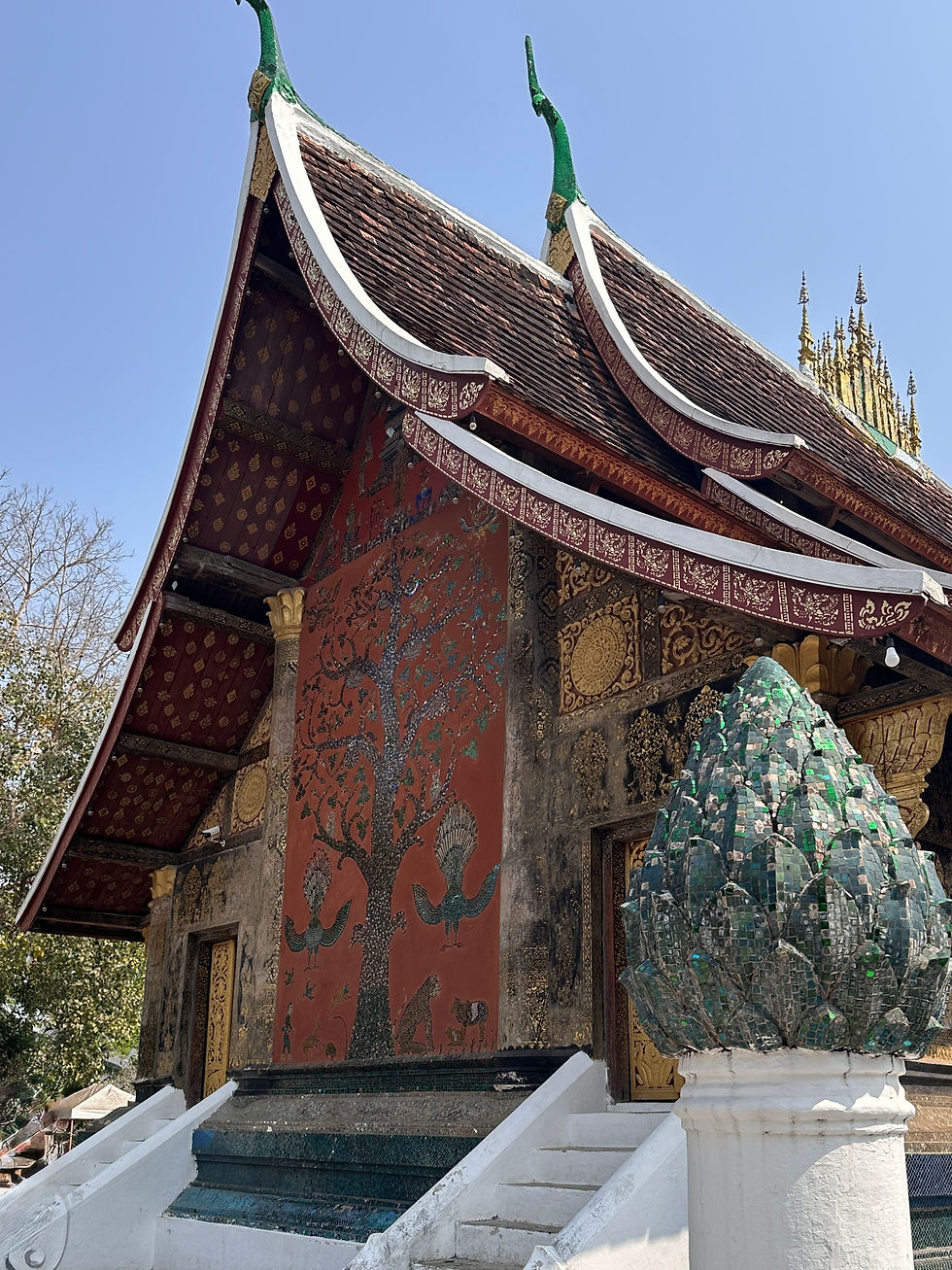
Chan told us the story and moral attached to the turquoise-coloured mosaic in the corner. I’m not going to tell the story in case I get it wrong, but it held the moral of a young’s man devotion to either his mother who loved him or to his rather evil wife who despised his mother and treated her poorly.

At the temple site, the Royal Carriage House holds the carriage built to carry the bodies of deceased kings. Chan explained that the kings had to be placed in a kneeling position to fit in the large urn-shaped coffin. The ornate carriage is almost 12 metres high and is ‘protected’ by seven ‘nagas’ (serpents). The building also houses other relics and religious images.
Chan then lead us on a walk around the town, stopping at the Heuan Chan Heritage House, a restored 19th century house owned by Mrs. Chan who had 18 children (‘Heuan’ means ‘house’ so House Chan). Tour guide Chan joked that he was NOT one of the 18 children! He told us up to 30 people (family and workers) lived in the house. The Heuan Chan Heritage House was preserved to tell the life of Luang Prabang over 100 years ago and was one of the first renovations in Luang Prabang’s historic revitalization project.
Ceremonial room:
Kitchen and eating area:
Musical instruments:
Once again, Chan returned us to the hotel to relax and cool off from the heat before picking us up for a late afternoon visit across the river by ferry boat for a glimpse of local life in the village Ban Xieng Maen, away from the tourist areas. Here, we first visited the small Wat Long Khoun temple dating to the 18th century. Again, this was a simple, humble, and austere temple, but no matter how big or small, Chan explained that all temples have five components: a temple, a drum, a stupa, monks’ quarters, and monks’ dining area. It seems that all ancient temples have a story (maybe true, maybe not) attached. The story to this temple is that the Chinese army stayed there late in the 18th century planning to attack Luang Prabang, but they could not sleep due to ghosts, so they painted two Chinese deities inside to protect them, and they could then sleep.
We next visited the Wat Chomphet temple reached by 123 stairs, high above the Mekong. It is such a serene place, I can understand why three travelling buddies would want to sit and chat. It is a popular temple to visit, especially at sunset. It dates to 1888, and had been used for royal coronation ceremonies of Luang Prabang kings.


Th drum and stupas:
The view of Luang Prabang across the Mekong was stunning.

We finished with a stroll around the village where the villagers were enjoying the slightly cooler evening.
Our final stop of the day was to, once again, watch the sun set on the Mekong.
Chan had some unique photo angles as the sun set:

If our first day was about seeing some of the main historic sights in Luang Prabang, our second day was all about off the beaten path - way off the beaten path to local ethnic minority villages. We hopped into a Toyota Landcruiser with driver Pob, and we were soon to learn why we needed such a vehicle with an experienced driver. First, though, we stopped at a local stationer to buy notebooks, pencils, and crayons for the village children.
Between Chan and the local people, we gathered some general information about life in Laos’ rural mountain villages. These people appear to be completely self-sufficient, growing rice and vegetables and fruit, and raising a few animals such as cows and fowl. They have to boil water to drink (we saw an older lady take water from the stream in plastic bottles). They have a primary school, but older children have to walk or ride a scooter to the next village. The villagers were so kind and open and inviting (which I am sure was due to Chan’s ability to talk to them and engage - this is why you hire a local, private guide). We learned that women give birth in the villages with the help of a midwife and an herbalist. (For an interesting article about infant mortality, refer to ‘Lao PDR 2023 child mortality’ at unicef.org. In Laos, the under-5 years of age mortality rate was 28 per 1,000 live births in 2023; and 28 is the average - the rate is about 41 in very poor areas compared to 12 in wealthier households; in comparison, Canada’s rate is 5 per 1,000.) Chan explained that the birth rate in villages is dropping to about two or three children per family. More often, the young people are leaving for Luang Prabang to study and then starting their adult life in the city.
Our driver Pob steered us first to Ban Bo Hae, a small village of what is known as a ‘lowland’ ethnic minority group. We reached the village by walking down a steep hill and crossing a wooden bridge which we later learned was constructed by the people without assistance from government. We were eagerly invited to sit on a step with a local lady and ask any questions we wanted.
Gathering water:

Leaving Ban Bo Hae, we turned pretty much straight up a mountain on what we would call a forestry trunk road, barely gravelled, with potholes that give a whole new meaning to the word ‘potholes’ - thus, the need for driver Pob and the Landcruiser. Although the drive was barely 10 kilometres, it took considerably longer than what one would think. When I asked Pob what he thought of this road, he smiled and said he liked it as he is an “experienced driver”(I can certainly attest to that). We eventually arrived at Ban Long Lan, a village of a ‘highland’ ethnic minority group. It was at this village that a young boy, maybe 13 years old, told us he walks to the secondary school in another village on Sunday afternoon, stays in a dormitory, and returns Friday afternoon. We were shocked because the road is steep and harsh. He just shrugged his shoulders and said he knows a short cut. Well, I cannot imagine what the ‘shortcut’ would be like as the village is quite literally at the top of a mountain. Yes, the Laotian village children have a whole different skill set. We met one small girl who told Chan that she did not go to school as her father abused drugs. She should have been in primary school. Chan kindly told her to learn all she can from her friends who go to school.

As we strolled the two villages, we handed out the pencils, notebooks, and crayons. We were impressed with how humble the children were in both villages, initially refusing the ‘gift’ until Chan engaged in conversation with them, asking their age and what school grade they were in. They would finally take the book and pencil and then leave, soon to be followed by little friends who also eventually accepted books. They were so grateful because clearly they have nowhere anything in the way of toys and books that our American children have. (Although Chan said it was fine to take photos, I am not going to post any identifible pictures.) Here’s a picture of four children happily setting off with their notebooks and pencils and crayons.

Our two village visits certainly gave us a glimpse into authentic life away from the main tourist sights and the more developed areas of Luang Prabang, and we are so grateful for the experience. Just as they thanked us, we thanked them. This would not have been possible without Chan with his local heritage and 20 years experience as a tour guide.
By this point, we were hot and tired, and Pob transported us to Pak Ou (from where you could hop a ferry boat to the Pak Ou caves on the other side of the Mekong) for a Thai lunch overlooking the river. It was delicious, especially the grilled fish.
That would have been plenty for a great day, but we had two more stops in a suburb of Luang Prabang called Ban XiengKhong known for its authentic craft production. First, we stopped at a silk producer where Chan explained the process of traditional silk-making, from worm to finished product. You know, you buy silk but have you ever thought how it was made? (As an aside, Chan knows a lot about a lot of things. He had to present his tour guide credentials at the Wat Zieng Thong temple to confirm that he is a licensed Laos guide with the education and experience to present the correct historic information. He had all his documents, along with 20 years’ experience.)
From worm to loom:
Our next stop was paper-making and, once again, Chan explained the process of making what is known as Sa paper. Traditionally, the bark of the mulberry tree, or ‘sa’, is used by harvesting, boiling, cleaning, pounding to a pulp, spreading on a screen with water at which time flowers might be added for design, and dried into paper. We got to try our hand at adding flowers and leaves. If you wish, elephant dung could also be used. Rest assured, it is washed thoroughly and boiled with disinfectant before being processed into paper. It is apparently very eco-friendly as it is an alternative to wood.
From mulberry bark to paper (minus the cleaning and pounding which was not being done when we visited):
Bev and I lent our hand at decorating a piece of paper. We thought we were pretty good.
And that concluded our wonderful two day tour with WanderLaos and our incredible guide Chan. Looking back, we packed a lot into three days with new information, sights, and smells; and we have no regrets (except not taking out Laotian Kip so I could buy those deep fried bananas and other delicacies).

So, do visit Luang Prabang and do see some historic sights in this UNESCO city; but do also get off the beaten path for the freshest air, some gritty roads, and a glimpse of rural life. And don’t forget the Laotian Kip - you’ll need it.
Our next stop is Hanoi, Vietnam.
Thanks for reading.


Very Interesting and beautiful pictures.